Why Nx for Enterprise Frontend Scale

The boundary between what my team owns and what another team owns used to live in people's heads. Now it lives in the build.
TECHNICALNobody sold me Nx as a build speed thing. Nobody stood up in a meeting and said "let's make CI faster." What I actually heard was closer to: "nobody can tell me who owns this shared component anymore."
That sentence is the real reason we moved. The build time drop was just a number that showed up afterward.
What it looked like before
We had one Angular repository, no Nx, several teams working in it at the same time. Any file could import anything. There was no technical wall between a feature module and a piece of shared infrastructure, only the assumption that people would be careful.
For a while that assumption held. Then the codebase grew, people rotated between teams, and the mental map nobody had written down started falling apart. A full build took around 15 minutes, and that was the visible cost. The invisible cost was worse: nobody could say with confidence what depended on what.
What actually changed
We migrated to an Nx monorepo. The build time dropped to around 5 minutes, mostly from the affected graph and caching, only rebuilding what actually changed instead of everything, every time. The cache keys off file hashes, so a change in one library does not force a rebuild of everything downstream that never actually touched that change.
That part is nice. It is also not the point. If speed had been the only win, I would not be writing about it. Plenty of teams speed up CI and still ship the same architectural mess, just faster.
The part that actually mattered
Nx gives you tags, and a lint rule that enforces module boundaries based on those tags. Once that is wired in, "this feature should not import that internal module" stops being a sentence someone says in a PR comment and becomes a build failure.
That is the shift. Before tags, a boundary violation was a social problem. Someone had to notice it, care enough to flag it, and be willing to have that conversation in review. In a big org, all three of those things are unreliable at scale. People are busy, reviewers rotate, and the person best positioned to catch a violation is often the one with the least time to look for it.
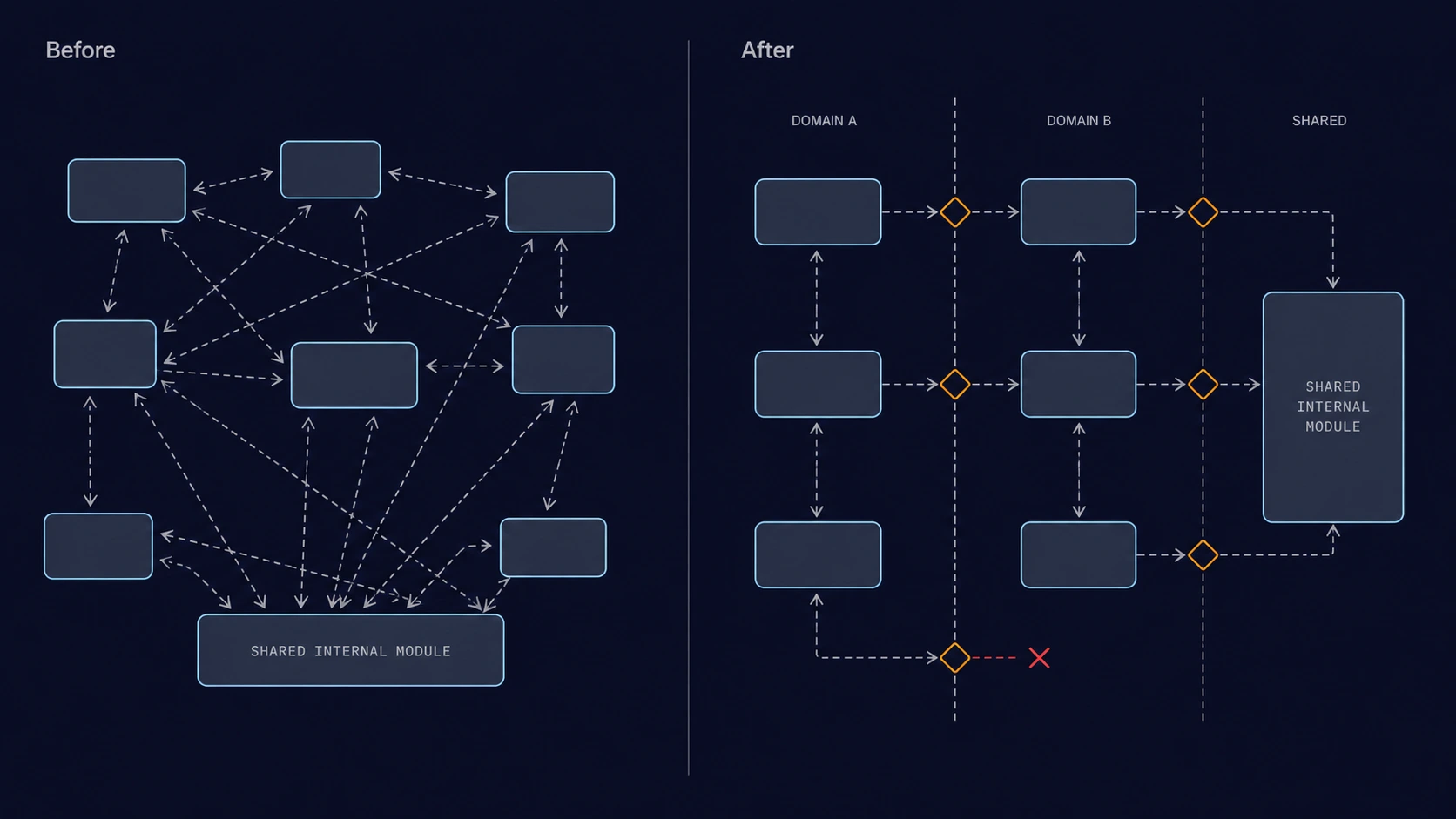
I have seen the same pattern play out more than once, in different shapes: a feature team under deadline pressure reaches into a module that belongs to someone else, because it is faster than asking, and because nothing in the tooling stops them. It works. Nobody notices in review, because the reviewer is looking at the diff, not the dependency graph in their head. Then months later, a change in that internal module breaks something nobody expected it to touch, and the first question in the incident channel is "wait, who is using this?"
With enforced boundaries, that question gets answered before the code merges, not after it ships.
What this costs you
I want to be honest about the tradeoff, because it is real. Setting up tags is not a one-time task you finish and forget. Every new module forces a decision: what domain does this belong to, what scope, who is allowed to depend on it. That is friction. You feel it every time you scaffold something new.
The difference is that it is friction on purpose. You are paying a small, visible cost up front instead of an invisible, compounding one later. I would rather spend thirty seconds deciding a tag than spend an afternoon six months from now tracing why a checkout feature is somehow coupled to an internal auth utility nobody remembers exposing.
What it does not do
Nx does not design your architecture for you. It will happily let you draw the wrong boundaries and enforce them perfectly. Tags do not know if your domain split makes sense, they only know if you are respecting the split you already chose.
So this is not a tool that replaces architectural thinking. It is a tool that makes your architectural decisions stick once you have made them, instead of quietly eroding the moment someone is in a hurry. In a codebase touched by one person, you do not need that. In a codebase touched by five teams who do not sit in the same standup, you do.
The actual case for it
If someone asks me today why we use Nx, the honest answer is not "the build is faster," even though it is. The honest answer is that the boundary between what my team owns and what another team owns used to live in people's heads, and now it lives in the build. That is a smaller claim than "Nx makes everything better," but it is the one I can actually stand behind.
If you are on a single-team project, this might be overkill. If you are past the point where anyone can hold the whole dependency graph in their head, it is probably not optional anymore, it is just a question of before or after the incident that makes it obvious.
I'm writing the next one on where state actually lives in a big Angular app, same level of boring and useful. Worth subscribing if that kind of thing is useful to you.
Nx tags did not make our build faster, that was a side effect. What it actually did was turn module ownership from a social agreement into a build failure.